The Leapfrog Delusion: Sophia, Phronesis, and the Missing Entry Rung
Historically, knowledge workers were compensated for their deliverables rather than their underlying judgment. Clients paid for the finalized contract, the valuation model, or the board deck; the years of trial and error required to produce it were simply the assumed cost of entry. That distinction never mattered because there was no other route to the output. Now there is.
Economic modeling from the Anthropic Institute projects that under rapid adoption scenarios, AI impacts roughly half of the tasks performed by cognitive workers by 2030, pushing cognitive wages 11.5% below their historical trajectory as markets purchase the lowest-cost task execution. In that same projection, GDP finishes 32.4% higher while the actual stock of human knowledge rises by just 0.61%. We get a third more output and a rounding error more understanding, because true discovery remains bottlenecked by physical and operational reality.
Sophia Versus Phronesis
The half of knowledge work being automated is routine execution and theoretical synthesis: what Aristotle in the Nicomachean Ethics called sophia. A language model generates sophia on demand, producing a clean memo in four seconds.
What remains scarce is phronesis: practical wisdom. It is the executive judgment required to decide what to do in a contested, specific case, forged by wrestling with real-world constraints and getting things wrong. It is the instinct to spot when a division head’s stated problem contradicts their incentive structure, or the caution to question a revenue forecast that looks mathematically tidy and operationally impossible.
The Missing Entry Rung
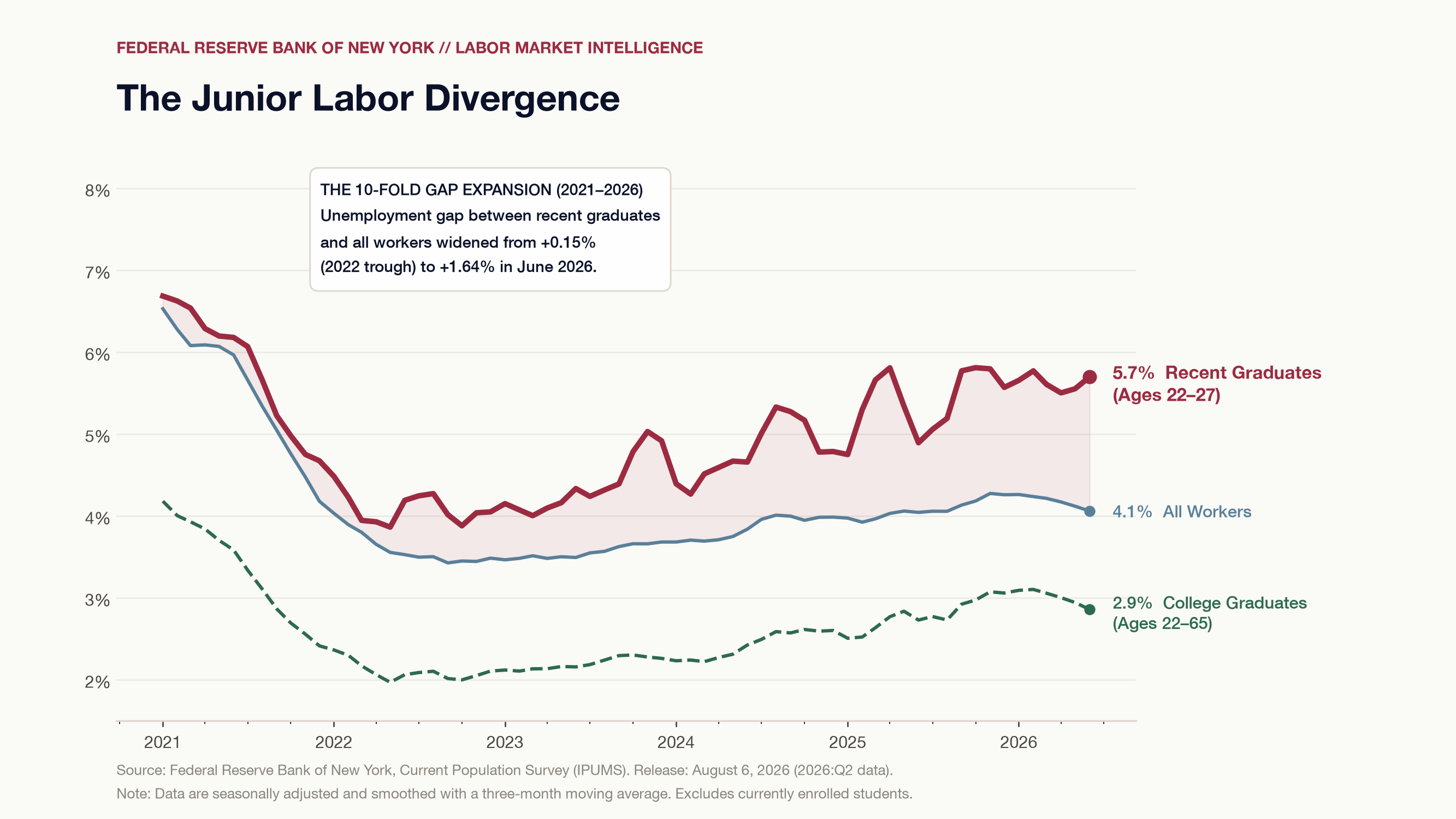
In summer 2026, the Federal Reserve Bank of New York put a hard number on the junior labor market: unemployment for recent college graduates reached 5.7%, well above the 4.1% rate for the broader workforce. Universities have responded by launching at least 74 undergraduate majors and 89 minors in artificial intelligence, arguing that because automation absorbs entry-level work, graduates must arrive ready to operate at the second rung of the professional ladder.
Call this the leapfrog delusion. You cannot step onto the second rung of professional judgment without standing on the first.
For decades, the entry-level analyst role served a dual function. The employer bought routine execution: checking vendor contracts, reconciling financial tables, and auditing data rooms. The junior professional received something far more durable: a supervised environment to make fifty small mistakes. Those routine tasks functioned as the primary training weights of executive intuition.
We can now measure synthetic fluency to a decimal place and generate the illusion of sophia on demand, yet most organisations have dismantled the apprenticeship engine that builds the phronesis required to supervise it.
Hiring partners and corporate boards already discount prompt literacy. They need practitioners who recognize when an automated synthesis introduces structural risk. Classroom credentials cannot replace the missing entry rung; organisations must deliberately redesign how practical judgment is forged.
Private Briefing
Navigating a high-stakes strategic inflection or boardroom narrative?
Itúy advises chief executives, corporate boards, and founders on strategic decision architecture, executive storyboarding, and AI governance.